Contact Us
office@taxsherpa.com
(678) 944-8367
Follow Us:

Work Less, Live More:
Slash Your Tax Rate
After Filing 50,000 Tax Returns I Discovered the Secrets to Tax Savings
As Seen & Heard On...


Accounting
They professional, well versed and educated to address my needs. I feel very comfortable moving forward with their services.

Business Accounting Services
Amazing service! Called right away and provided so much information and support!

Tax Sherpa by far is the best in fulfilling your tax needs. They provide top notch customer service and are always willing to help.
Neal is exceptional at the work he does and always looks out for the best interest of his clients. Serena is amazing and keeps communication line open at all time. Thank you Tax Sherpa for your service.

Tax sherpa has been quite good in helping me with my monthly accounting and understand tax saving strategies and has been very low effort on my end compared to tax services I have used in the past.
If you own your own business Tax Sherpas can really switch the extra tax burden on it head for you and save you thousands, while charging very fair fees for service.
The Tax Sherpa Mission
At Tax Sherpa, our mission extends beyond the numbers. We are passionately committed to empowering solopreneurs and small business owners by saving them tens of thousands on their taxes. We firmly believe that prosperity thrives when individuals retain more of their hard-earned money. It's not just about good business sense; it's about fostering a world where people's pockets, not the government's, hold the key to positive change.
Book a Survey Call Now
Hop on a call with one of our tax experts to go over your individual situation.
Personalized tax assessment
Expert strategies tailored for you
Potential to discover significant tax-savings opportunities
Pick any available time on our calendar to start saving today.

Our Services
Learn a little more about the core services we offer:

Tax Advisory
Unlock your path to significant tax savings with our Tax Advisory services. Our experts craft, implement, and consistently update tailored tax strategies that not only align with your unique business needs but also pave the way for maximum tax efficiency.

Tax Filings
Realize your tax savings annually without the hassle. With our Tax Filings service, we meticulously handle the paperwork, ensuring every tax advantage is captured when submitting to the government. Experience peace of mind, knowing that every deduction and saving is realized for you.

Bookkeeping
More than just numbers on a ledger, our Bookkeeping service helps you maintain a clear picture of your revenue and expenses. By seamlessly integrating tax strategies into your books, we ensure that your records not only stay organized but also accurately mirror your financial blueprint, keeping you aligned with your tax-saving goals.
About Us

Neal McSpadden,
Chief Tax Strategist
I went from owing the IRS over $1,300,000 to Zero, and in the process of fixing my own mess I discovered the hidden world of tax planning.
Over the years, I've worked on over 50,000 tax returns covering billions of client earnings and have helped save clients hundreds of millions of dollars.
What I discovered through this whole process is that:
The large companies (that can afford to pay 6-figure fees) get great tax advice.
The simple W-2 earner with no other activities end up filing for themselves or go down to the corner tax preparer office. They generally get mediocre advice, but it's good enough for now.
The people in the middle, solopreneurs and small business owners, can't afford the fees of the big companies and are unable to get good service from the corner preparers.
Those people are who we aim to serve.
Our Core Values
Our Philosophy
Our core philosophy is that the solopreneurs and small business people are the backbone of our entire society. Without them, nothing else works.
The current system that places undue tax burdens on this group needs to be changed and defunded.
Our Promise
Our promise to you is to craft an individualized plan for your individual situation. All taxes are personal, and everyone's life is different.
Our Guarantee
We guarantee you will save multiples of our advisory service fees.
When we create your custom tax blueprint we will show you exactly how much you might save based on your current circumstances.
Our Blogs

Audited by Algorithm: How AI Is About to Change IRS Audits Forever
The Bottom Line, Up Front
Within five years, the majority of IRS notices will be selected and generated by AI. The single biggest source of new enforcement revenue will not be audit findings — it will be default judgments against taxpayers who don't respond. The only durable defense is to build your own AI substantiation system so your records are ready before the notice arrives, not three years after.
Posted by Neal McSpadden — Tax Sherpa
Reading time: ~20 minutes
Here is the operational reality compressed into one paragraph:
Palantir has built the unified data foundation underneath the IRS since 2018 — more than $200 million in cumulative contracts (FedScoop, Sept 2025). On top of that data layer sits what I'll call the AURA stack— Automated Underreporting and Risk Assessment — which combines the existing Automated Underreporter program (AUR), the Dependent Database (DDB, classified by GAO as first-wave AI), the Systems Research and Application (SRA) machine-learning model, and Fair Isaac (FICO) risk scoring (FedScoop, May 2024). The Large Partnership Compliance (LPC) AI model already proved the pattern works at the top of the income scale — 82 high-risk returns flagged, 75 active audits, 500 automated soft notices (Ryan & Wetmore, Sept 2025). The $696 billion gross tax gap (IRS Publication 5869) — 61% of which comes from pass-throughs and sole proprietorships (CRFB, March 2025) — forces the rollout to the middle of the market. The trap is the default-assessment mechanism under IRC §6212: 35-42% of correspondence audit notices already close with no taxpayer response (Taxpayer Advocate, May 2022), and that silence converts a proposal into a legally binding assessment. The only thing rate-limiting the system is the U.S. Constitution — which requires substantive human involvement in any formally contested case (Richmond JOLT, 2022).
What this means for you, today:
If you receive a notice from the IRS, respond. Silence is the single most expensive decision a taxpayer can make.
Build contemporaneous records now. Calendar entries with attached documents, AI meeting note-takers, automated bookkeeping, and source-document storage. If your records get assembled three years after the fact, you have already lost.
Stop being a Schedule C if you can avoid it. Sole proprietors misreport income at a ~55% rate (CRFB) and will be the primary target of the next wave of AI enforcement.
Fight AI with AI. The winning strategy is an always-on substantiation system that can answer the IRS's AI before a human ever opens your file.
The rest of this article walks through how I arrived at that conclusion — the systems already in production, the documented government direction, the legal scaffolding, and what you can do starting this week.
Audited by Algorithm: How AI Is About to Change IRS Audits Forever
The Palantir Foundation: 2018 to Today
The AURA Stack: What's Already Running
Layer 1 — Underreporter matching (the "AUR" half)
Layer 2 — Risk assessment scoring (the "RA" half)
Layer 3 — Specialized risk models bolted onto the AURA stack
The Funnel: 2.8 Billion Returns to 2.9 Million Reviews
Proof of Concept: Large Partnership Compliance
The Trap: Default Assessment by Silence
1. Get a real entity structure
2. Build always-on substantiation
3. Build an AI substantiation layer on top of your records
4. Respond to every notice. Always. On time. With documentation.
5. Push into the top of the funnel deliberately
Automated notices and default assessments
Video Presentation
Get the slide deck: https://assets.cdn.filesafe.space/4Wismid0omq9dOEtvtBg/media/6a10ba493c3aed7c6389a5d8.pdf
The Palantir Foundation: 2018 to Today
Before AI can be deployed on tax data, the data has to be unified. For decades it wasn't. The IRS ran on more than 60 different legacy systems written in COBOL, with over 700 separate case-selection methods, and no single source of truth across business and individual records. The first job was plumbing — and that job was given to Palantir.
2018 — The original $99M Gotham contract. A 2019 law review article by Sideman & Bancroft, Do IRS Computers Dream About Tax Cheats?, documented that "the IRS signed a deal with Palantir Technologies for $99 million over seven years," deploying Palantir Gotham — the same system used by the CIA and DoD — to "integrate and transform data, regardless of type" (Sideman & Bancroft / Federico & Thompson, 2019).
2024 — The SNAP contract. In December 2024, the IRS Transformation and Strategy Office awarded Palantir a $1.8 million Selection and Analytic Platform contract — explicitly to "deploy three case selection methods and three AI models" and migrate workflows from Gotham to Palantir Foundry. Barry Johnson, then IRS Chief Data and Analytics Officer, stated the goal was "to move the operational audit functions out of the research environment and get it into the operational environment where it belongs, so that it could be more flexible and would work in closer to real time" (Tax Notes via LinkedIn, Feb 2026).
2025 — The Foundry mega-API.WIRED reported in April 2025 that Palantir, DOGE, and IRS engineers were building a unified API layer over every IRS database — envisioning Foundry as "the read center for all IRS systems" where authorized users could view, and potentially modify, all IRS data in one place (WIRED, April 2025).
Cumulative spend.Palantir has been paid more than $200 million by the IRS since 2014, and Criminal Investigation has used Palantir tools since at least 2019. The IRS has a renewed Blanket Purchase Agreement that allows IT to procure Palantir services without re-competing — the contractual fast lane (FedScoop, Sept 2025).
What SNAP actually does.Public records requests show SNAP is "designed to surface the 'highest-value' targets for audits, unpaid tax collection, and potential criminal investigations" by pulling from "a maze of legacy IRS databases and analyzing unstructured data from supporting documents, including potentially public transaction records from platforms like Venmo and storefronts like Etsy and Depop" (Change.org petition citing FOIA documents, 2026).
The plumbing is done. The pipes connect everything. Now the agency is filling them with AI.
The AURA Stack: What's Already Running
The IRS doesn't publicly market a single system called "AURA." But the term accurately describes the documented multi-layer architecture that performs automated underreporter matching + risk assessment scoring + audit selection as one integrated pipeline. Every component is public record — in the Internal Revenue Manual, in GAO reports, in TIGTA audits, in IRS Privacy Impact Assessments.
Layer 1 — Underreporter matching (the "AUR" half)
The Automated Underreporter (AUR) Program matches third-party information returns — W-2s, 1099s, 1098s, K-1s — against filed tax returns. Per Urban Institute research, the IRS received2.8 billion information returns in 2018and detected22.3 million discrepancies, of which2.9 million were selected for further review (Urban Institute, 2022). That selection funnel is the source of every CP2000 and CP2501 notice taxpayers receive.
Per the Klasing & Associates analysis of IRM 4.19.3, AUR "uses third-party reporting and automation to force a fast decision: agree, dispute with documentation, or risk escalation into assessment, statutory deficiency procedures, and eventually collections." When no response occurs or the notice is undeliverable, the IRS issues a statutory notice of deficiency (CP3219A) inside the AUR program itself (Klasing & Associates, March 2026).
This is the AI-notice pipeline I'm forecasting — but the front end is already running, today, at industrial scale.
Layer 2 — Risk assessment scoring (the "RA" half)
Once a return is in the pool, the agency scores it.
The Dependent Database (DDB)is classified by GAO as first-wave AI "due to it having 'expert knowledge encoded into a computer system'" (FedScoop, May 2024). DDB applies rules and scoring points to returns during processing, drawing on internal IRS data plus external data from Health & Human Services, the Federal Case Registry of child support orders, and Social Security Administration parent-child linkage data (IRS Dependent Database PIA) (IRS — Dependent Database and EITC presentation). DDB runs in apre-refund environment — the money is stopped before going out the door.
The Systems Research and Application (SRA) Clementine model is classified by GAO as second-wave AI— explicit data-mining and machine learning. Once a return is flagged by DDB, the SRA model assigns the filer's risk score. The Wage & Investment Division "ranks risk scores from highest to lowest" and works from the top until hitting its "predetermined audit workload." AFair Isaac (FICO) model also runs inside the DDB pipeline (FedScoop, May 2024).
The Internal Revenue Manual makes the automated nature of this explicit. Per IRM 4.1.26: "Correspondence Examination audit inventory is primarily selected systemically using risk-based scoring criteria" (IRM 4.1.26). The highest-volume audit channel in the IRS is already AI-selected.
Layer 3 — Specialized risk models bolted onto the AURA stack
The agency is no longer just scoring. It is recommending specific issues.
The Individual Taxpayer Model (Form 1040)— a machine-learning classifier that analyzes every return and recommends the top three issues most likely to require adjustment. It runs six times per tax year and learns with each iteration (Ryan & Wetmore, Sept 2025).
The Line Anomaly Recommender (LAR)— replaced the older Discriminant Analysis System for mid-size corporations ($10M-$250M in assets). LAR analyzes relationships among line items rather than isolated anomalies — relationship-graph reasoning at the entity level (Ryan & Wetmore, Sept 2025).
The Return Review Program (RRP)— refund-fraud detection using "leading edge machine learning technologies" with both supervised and unsupervised models (Urban Institute, 2022).
129 AI use cases as of 2026, up from 54 in 2024— the IRS inventory more than doubled in two years (CapTech, Feb 2026). TIGTA's November 2024 special report (No. 2025-IE-R003) confirmed that as of February 2024, the IRS had 68 AI projects —27 in enforcement, 12 in customer service, and 29 in operations, with 30 already in use and 38 in development (Thomson Reuters, Dec 2024).
The IRS's own Strategic Operating Plan (Objective 4) commits to "Advanced Compliance Analytics: The IRS will use enhanced data and analytics capabilities to select compliance cases based on highest risk of noncompliance" — with the explicit goal of narrowing the tax gap (IRS Publication 3744a). This is not me speculating. This is the agency's stated, published trajectory.
The Funnel: 2.8 Billion Returns to 2.9 Million Reviews
The physics of an AI audit pipeline is a funnel that starts impossibly wide and narrows down to human review only at the very bottom — and only for taxpayers who push back.
Top of funnel: 2.8 billion information returns ingested annually (Urban Institute, 2022).
Mid funnel: 22.3 million discrepancies automatically flagged by AUR matching.
Selection pool: 2.9 million returns selected for compliance review.
Notice volume: Approximately 9 million CP2000-family notices issued annually, including initial notices, interest adjustments, and follow-up correspondence in the AUR notice family.
Audit closure: Of correspondence audits, 35-42% close with no taxpayer response (Taxpayer Advocate, May 2022) (Legal Aid Society, March 2026). In FY 2009,18.4% of computer-identified discrepancy cases closed without contacting the taxpayer at all (CIAT — AUR Efficiency Analysis).
That last number is the one that should get your attention. Nearly one in five computer-flagged discrepancies has, for over a decade, been closed by the IRS with zero human touch on either side of the transaction. That is the working template the agency is now scaling up with AI.
In the old days, even attempting this volume was structurally impossible — random selection and manual classification couldn't handle it. In the current AI-powered modality, 100% population analysis is the default. The funnel doesn't get narrower because AI runs out of capacity. It gets narrower because taxpayers stop responding.
Proof of Concept: Large Partnership Compliance
If you want to know what the AI audit future looks like, look at what the IRS already did to the top of the income scale.
In September 2023, IR-2023-166 announced that AI would be used to send notices of examination to 75 partnerships averaging $10 billion in assets, plus500 "soft notices" to partnerships with over $10 million in assets showing balance-sheet discrepancies. The exact language: "Partnerships receiving the notices may be added to the audit work stream, depending upon their response" (KPMG / Tax Management Memorandum, Oct 2023) (Holland & Knight, Oct 2023).
That sentence is the entire AI audit doctrine in 19 words. AI selects. Notice is sent. Whether you get a real audit depends on how you respond. Silence is a verdict.
The underlying tool is the Large Partnership Compliance (LPC) Model— the IRS's first AI-driven enforcement tool that "applies machine learning to the entire population of large partnership returns." In Tax Year 2021, LPC flagged 82 high-risk partnership returns for examination — versus near-zero audits in prior years for this segment (Ryan & Wetmore, Sept 2025).
Pre-LPC numbers for context: large partnerships (>$100M assets) had a 0.3% audit coverage rate. Partnerships with >$10M assets had a 0.1% coverage rate. The average audit took 1.7 years and 80% resulted in no change — meaning the historical model burned IRS employee time on cases that produced zero revenue (Ryan & Wetmore, Sept 2025).
Post-LPC: 82 flagged, 75 active audits, 500 soft notices, all in a single tax year. The pattern works. The only question is how far down the income scale it gets pushed — and the answer is "down to wherever the tax gap is biggest."
Why You're Next: The Tax Gap
The IRS publishes a Tax Gap Report every few years. The findings are remarkably consistent: roughly 85% voluntary compliance, another ~2% recovered through enforcement, leaving a ~13% gap the agency considers stolen revenue.
For Tax Year 2022, the latest projection from IRS Publication 5869:
Gross tax gap: $696 billion
Net tax gap (after enforcement): $606 billion
Underreporting alone: $539 billion(77% of the total)
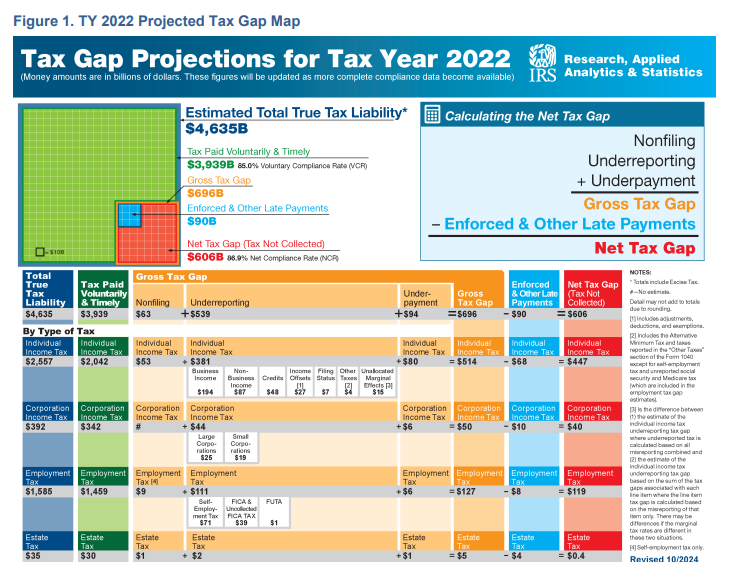
A one-percentage-point increase in voluntary compliance would generate approximately $46 billion in additional revenue (IRS Tax Gap page) (IRS Pub 5869).
Now the part that should make every small business owner sit up straight. From the Committee for a Responsible Federal Budget's analysis of the TY2022 tax gap projection:
61% of the gross tax gap comes from unpaid business and self-employment income taxes, the vast majority from pass-through entities (sole props, partnerships, S-corps). Wages have a misreporting rate of approximately 1%. Sole-proprietor business income has a misreporting rate closer to 55%.
The math from the agency's perspective is simple. The largest single source of unpaid tax is sole proprietors. The historical enforcement model couldn't reach them because correspondence audits scale poorly and field audits scale not at all. AI selection plus automated notice generation plus default-assessment-on-silence solves that scaling problem in one move.
If you file a Schedule C, you are in the bullseye.
This is also exactly why I tell clients to get out of Schedule C status whenever the numbers support it. An S-corp or partnership structure isn't just tax efficient — it's audit defensive. It pulls you out of the demographic the agency's statistical models flag hardest.
The Trap: Default Assessment by Silence
This is the part most taxpayers don't understand, and it is the entire game.
A CP2000 notice looks like a bill. It has a balance at the bottom of the front page. People who don't read further assume it's final. People who do read further see that it is technically aproposal of additional tax. But the procedural reality is brutal: if you don't respond, the proposal becomes the bill, automatically, by operation of law.
Under IRC §6212, if a taxpayer fails to respond to a Notice of Deficiency within 90 days (150 if abroad), the proposed tax becomes legally final and the Tax Court path is forfeited (IRS — CP3219N) (Taxpayer Advocate — 90-Day Notice of Deficiency) (IRM 4.8.9).
And there is already a system in production that does this end-to-end with zero human involvement. From the National Taxpayer Advocate:
"With its Automated Correspondence Examination System, the IRS automatically processes correspondence audit cases from creation to statutory notice to closing without any tax examiner involvement when a taxpayer does not respond to IRS correspondence."
(Taxpayer Advocate NTA Blog, May 2022)
The Automated Correspondence Examination System — ACES — is the future state I'm describing, already operating today for low-income taxpayers. The only thing that changes when AI scales it up is the volume.
I know this trap personally. In 2007 I received an IRS letter saying I owed $1.3 million. It was not true. I panicked, ignored it, ignored the next one, ignored certified mail, and then the IRS started garnishing my wages down to roughly $200 per paycheck. That experience is what put me into tax work in the first place. The single most important thing I can tell anyone is: if you get a letter from the IRS, open it, read it, and respond. Even a "I disagree, more information to follow" response preserves your rights.
Nina Olson, the former National Taxpayer Advocate, made the same point even more directly when she was hauled in front of Congress: the IRS audits low-income taxpayers at high rates not because the cases are easy to win — but because the taxpayers don't fight back. The 2019 testimony between then-Commissioner Charles Rettig and Senator Ron Wyden captures the same logic. Rettig explained that the IRS cannot simply shift examination resources from single-issue correspondence audits to more complex higher-income audits "because of employee experience and skillset" (Treasury letter to Wyden, Sept 6, 2019). Translation: poor people are easier to audit because their cases are simplerand they're more likely to default.
AI removes the skillset constraint. The default-assessment constraint stays exactly where it is.
The Constitutional Limit
Here is the one piece of the system that genuinely rate-limits how big the trap can get: substantive human involvement is constitutionally required at the point of formal adjudication.
The Richmond Journal of Law & Technology article AI, Can You Hear Me? Promoting Procedural Due Process in Government Use of Artificial Intelligence maps Judge Henry Friendly's 11 procedural due process elements — notice, neutral decision-maker, cross-examination, statement of reasons, judicial review — against AI decision-making and concludes that "decisions produced using AI appear to violate all but one or two of them" (Richmond JOLT, 2022).
The Yale Journal on Regulation puts it even more bluntly. An agency that "simply rubber-stamps an LLM-chosen course of action … has abdicated its duties to deliberate and explain." Agencies using AI must "reasonably explain, among other things, how it chose and developed its model, how it prompted the model and validated its outputs, and why it views those results as reliable" (Yale Journal on Regulation, Feb 2026).
Two related pieces of legal scholarship reinforce the point. Artificial Intelligence and Procedural Due Process (SSRN, March 2025) argues "due process demands a greater opportunity to contest government decisions that raise greater reliability concerns" — pushing for "glass box" interpretable AI as a constitutional minimum (SSRN 5093989). And the Cambridge volume Inalienable Due Process in an Age of AI argues there are hard constitutional limits on how far automated adjudication can go before due process violations attach, regardless of procedural workarounds (Cambridge Core, 2021).
The State Farm standard — that an agency action "runs counter to the evidence" qualifies as arbitrary and capricious — provides the judicial review backbone for unwinding bad AI-driven decisions.
Practical translation: if you respond on time, with documentation, and you formally contest the result, a human must enter the loop. The agency's available human capacity is the binding constraint on how many cases can be escalated. AI handles the bottom of the funnel; humans handle the top.
The implication for taxpayer strategy is brutal in its clarity. The funnel is engineered such that the vast majority of cases never reach a human. If you stay in the bottom of the funnel — by being slow, by being silent, by responding without adequate documentation — you will be processed by a machine. If you push into the top of the funnel — by responding fast, with airtight documentation, formally invoking your contest rights — the agency's own capacity constraints work in your favor.
There is a real bias problem alongside this. A May 2024 GAO report found unintentional algorithmic biases in the Dependent Database causing Black taxpayers to be audited at roughly 2.9× to 4.7× higher rates for Earned Income Tax Credit claims (FedScoop, May 2024). When you combine flawed training data with automated default assessments triggered by non-response, you get systemic rapid-scale harm without human checks. This is the existing system. AI scales it.
The Robodebt Warning
Former National Taxpayer Advocate Nina Olson has specifically named Australia's "Robodebt" automated welfare debt-recovery system — which wrongfully sent debt notices to welfare recipients en masse — as the warning case for IRS AI audit selection (Texas Society of CPAs, Jan 2026).
Robodebt is the concrete example of what happens when the AI-notice loop runs without adequate human review: the system was eventually ruled unlawful, hundreds of thousands of debts were wrongly issued, and at least some recipients died by suicide while disputing notices they could not understand and could not get human help with. An Australian Royal Commission ultimately scathingly condemned the program.
The legal and political backlash matters less than the operational lesson: an algorithmic enforcement system that runs at scale without adequate human capacity to review pushback will mass-produce wrong decisions. That is what we are about to import.
May 2025's TIGTA Report 2025-308-022 —The IRS Could Leverage Examination Results in Artificial Intelligence Case Selection Models and Improve Processes to Evaluate Performance— explicitly addresses AI in audit selection (Texas Society of CPAs, Jan 2026). The watchdog is actively reviewing this exact pipeline. The political and oversight infrastructure to push back exists. Whether it moves faster than the technology rollout is the open question.
What to Do: Fight AI With AI
If you've made it this far, here is the prescription, in the order I'd actually do it.
1. Get a real entity structure
If you're operating as a Schedule C sole proprietor and you have any meaningful net income, get out. An S-corp election, a partnership structure, or a multi-entity arrangement does three things at once: it cuts your tax bill, it adds procedural protections, and it pulls you out of the demographic the AI models hit hardest.The 55% sole-prop misreporting statistic is the bullseye on your back, and the agency is buying scopes.
2. Build always-on substantiation
The historical defense — assemble records when the audit notice arrives — does not work against an AI pipeline that ingested your data in real time three years earlier. The winning strategy is contemporaneous capture.
In practice, that means:
Calendar entries for everything that has a tax consequence. Meetings with clients, business purpose of travel, home-office work blocks, vehicle use for business. The calendar is the timeline backbone.
AI note-takers attached to your calendar events. Zoom, Riverside, Otter, Granola, Fathom — pick one and use it on every recurring business call. The transcripts are your contemporaneous record.
Receipts attached to expenses at the point of capture. Not in a shoebox in March. Use a bookkeeping platform that supports document attachment per transaction.
Mileage logs that run automatically. App-based, GPS-driven, categorized monthly.
A document repository organized by tax year, by entity, by category. Google Drive, Notion, Box — pick one, set the structure once, and feed it monthly.
"Contemporaneous records carry far more weight during audits than reconstructed documentation. … An examiner can tell the difference between contemporaneous notes and after-the-fact reconstruction" (NSKT Global, Dec 2025).
3. Build an AI substantiation layer on top of your records
This is the part where my own work gets interesting. I am building an upgraded Family Management Company strategy that uses an AI-powered feedback system to automatically generate contemporaneous records, management and control documentation, directed actions, and the rest of the documentary scaffolding the IRS asks for during a partnership or employment-tax audit. With the new provisions in the One Big Beautiful Bill, a properly structured FMC can turn a teenager into a $26,000 annual deduction while bulletproofing the whole arrangement against AI audit vectors.
The general principle is broader than FMCs: any tax strategy that hinges on facts-and-circumstances documentation should now be designed with an AI substantiation layer from day one. If your structure cannot answer an automated IRS question in real time, your structure is fragile.
4. Respond to every notice. Always. On time. With documentation.
Repeat after me: silence is the most expensive decision a taxpayer can make. Eighteen-point-four percent of computer-identified discrepancies historically closed with no taxpayer contact at all. Thirty-five to forty-two percent of correspondence audits close with no response. Those taxpayers lost not because the IRS was right — they lost because the system is designed to take silence as agreement.
If you get a notice and you don't know what to do, find someone who does, the same week. Not the same year. The same week.
5. Push into the top of the funnel deliberately
Because the agency's human capacity is the binding constraint on escalation ,being escalation-worthy is a feature, not a bug. Formally contesting with documentation, demanding appeals, invoking Tax Court rights — these don't just protect you, they put you in the part of the funnel where the agency runs out of bandwidth fastest. The vast majority of substantive contests get resolved in the taxpayer's favor at the appeals level, not at Tax Court, because the agency has limited human capacity and the taxpayer who shows up well-documented becomes the expensive case to fight.
Closing Thought
The income tax did not exist until 1913. The Internal Revenue Manual is 60 years of patchwork. The Palantir contracts are seven years old. The AI audit models are mostly less than two years old. The default-assessment trap is older than any of it.
The piece that's new — the piece that should change how every small business owner does their books — is that for the first time in U.S. history, the cost-per-audit on the agency side is collapsing toward zero while the cost-of-defense on the taxpayer side is rising fast. The only sustainable response is to make your records cheaper to defend than the agency's notices are to send.
Forewarned is forearmed.
Want the Deeper Version?
This blog post is the public summary. The full strategy work — the entity structuring playbook, the AI substantiation system buildouts, the upgraded Family Management Company framework, the audit response templates, and the weekly office hours where I walk through actual notices clients have received — lives inside the Tax Strategy Network on Skool.
If you're serious about building the systems described above before the next wave of AI enforcement lands, that's where to be.
👉 Join the Tax Strategy Network: https://www.skool.com/tax-strategy-network/about
Full Source Bibliography
Palantir at the IRS
Sideman & Bancroft / Federico & Thompson —Do IRS Computers Dream About Tax Cheats?, 2019
Tax Notes via LinkedIn —What Kind of Work is Palantir Doing with the IRS?, Feb 2026
AURA stack components
Klasing & Associates — IRS Automated Under-Reporter Matching, March 2026
FedScoop —IRS AI Systems, Bias, Audits, Racial Disparities, GAO Report, May 2024
IRM 4.1.26 — Campus Exam Return Selection, Delivery and Monitoring
Ryan & Wetmore —IRS Using AI for Tax Audits in 2025, Sept 2025
AI audit programs in the news
KPMG / Tax Management Memorandum — Partnership Audits, Oct 2023
Holland & Knight —IRS Announces Sweeping Enforcement Effort Targeting Partnerships, Oct 2023
Thomson Reuters Tax & Accounting —IRS's AI Work Hard to Track, Dec 2024
Texas Society of CPAs — IRS Use of AI and Data Analytics, Jan 2026
arXiv —Balancing Innovation and Oversight: AI in the U.S. Treasury and IRS, Sept 2025
The tax gap
Automated notices and default assessments
Taxpayer Advocate NTA Blog — Correspondence Audit Communication Barriers, May 2022
CIAT —Improving the Efficiency and Effectiveness of the AUR Program
Due process and the constitutional limit
Yale Journal on Regulation — Minimum Administrative Law Standards for AI, Feb 2026
SSRN —Artificial Intelligence and Procedural Due Process, March 2025
Catholic University Journal of Law & Technology — Judicial Deference to AI Agency Action
Cambridge Core —Inalienable Due Process in an Age of AI, 2021
Treasury letter to Senator Wyden re: audit rates, Sept 6, 2019
Real-time response and contemporaneous records
NSKT Global —How to Avoid IRS Business Tax Audits 2026, Dec 2025
Vertex Inc. —What Are Continuous Transaction Controls?, Feb 2024
James Moore —Continuous Close / Real-Time Financial Reporting
This article is for educational purposes and does not constitute tax advice for any specific situation. If you've received an IRS notice or are concerned about your audit exposure, book a strategy session at taxsherpa.com.

Frequently Asked Questions
Q:
What's the difference between tax advisory and just filing my taxes?
Filing your taxes each year is a necessary task, but it is always backwards looking. Tax advisory works with you throughout the year to make sure that you are on the right track when it comes to your taxes and have strategies in place to save money now.
Q:
I've heard about tax write-offs for small businesses. What exactly can I write off, and how does it benefit my business?
Tax write-offs, also known as tax deductions, are expenses that a business incurs that can be subtracted from its revenue to reduce the amount of taxable income. Common write-offs include office supplies, mileage, rent for a business location, and advertising expenses, among many others. By writing off legitimate business expenses, you can significantly reduce your taxable income, which can lead to a lower tax bill. It's essential, however, to maintain proper records and ensure that the expenses are truly business-related.
Q:
What's the difference between a tax deduction and a tax credit?
A tax deduction reduces the amount of your income that is subject to taxation, which in turn can lower your tax liability. Common deductions include expenses like mortgage interest, student loan interest, and business expenses. A tax credit, on the other hand, is a direct reduction of your tax bill. This means if you owe $1,000 in taxes and have a $200 tax credit, your tax due would be reduced to $800. Some popular credits include the Child Tax Credit, the Earned Income Tax Credit, and credits for energy-efficient home improvements.
Q:
I'm thinking of hiring an independent contractor instead of an employee. Are there different tax implications for each?
Yes, there are significant tax differences between hiring an employee and an independent contractor. When you hire an employee, you're responsible for withholding federal and possibly state income taxes, Social Security, and Medicare taxes from their paychecks. You also typically pay unemployment taxes on wages paid to employees. Independent contractors, on the other hand, are responsible for their own taxes. As a business owner, you'd provide them with a Form 1099-NEC (if you pay them $600 or more during the year) instead of a W-2, and they would be responsible for their own self-employment taxes. It's important to correctly classify your workers, as misclassifying can lead to penalties.
Get in touch with us
Have questions? Use the form here and one of our knowledgable staff will get back to you as soon as possible.
(678) 944-8367
office@taxsherpa.com
2302 Parklake Dr NE Ste 675
Monday - Friday, 10:00 am - 5:00 pm
Send us a message
Follow Us
Follow Us
Disclaimer: The content presented on this website is intended for informational purposes only and is not tailored to the needs of any specific individual or entity. It should not be considered as financial, investment, or tax advice. The information provided is general in nature and does not account for individual circumstances or financial positions. Before making any financial or tax-related decisions, we strongly advise consulting with a qualified professional who can provide guidance tailored to your individual situation. All information on this site is provided in good faith, but we make no representation or warranty of any kind, express or implied, regarding the accuracy, adequacy, validity, reliability, availability, or completeness of any information on the site. Use of this site and reliance on its content is solely at your own risk.
Services
More
Contact Us
office@taxsherpa.com
(678) 944-8367
2302 Parklake Dr NE Ste 675
Atlanta, GA 30345
Monday - Friday, 10:00 am - 5:00 pm
© Copyright 2026. Online Tax Solutions Group LLC dba Tax Sherpa. All rights reserved.